Health Misinformation: Calling an Ambulance will get you Seen Faster in the Emergency Department
Updated: Aug 4

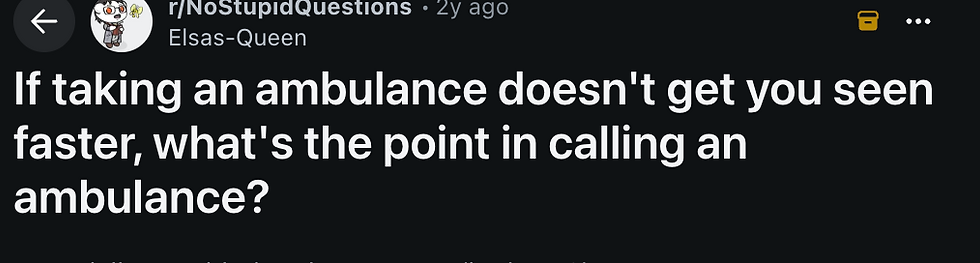
A common bit of misinformation perpetuated on social media about paramedicine is that "calling an ambulance will get you seen faster in the emergency department". In this post, I share a link to a Reddit thread that discusses this issue as well as two tweets that further perpetuated it. In the thread, the poster is American but states this issue as fact. The poster describes her own experience, which she feels would have been more timely if she had taken an ambulance.

Supported in Outdated Literature
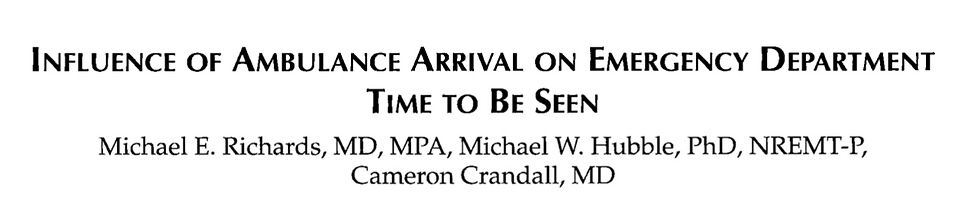
In an historical and rare (even to date) study, Richards et al. (2006) investigated the influence of arriving at the emergency department by ambulance rather than on foot. Though American, it is foundational to the narrative that has remained unchanged for many years, despite the healthcare system changing dramatically. Complaint type was not considered; only wait time. Their results showed a statistically significant advantage in arriving at the emergency department by ambulance compared with a walk-in (Richards et al., 2006). This is consistent with the information circulating about hospital wait times, but, as mentioned, it is outdated and does not reflect our current systems.
Additional Studies
Studies on acute conditions such as stroke or heart attack further show that hospital wait times are shorter for those arriving by ambulance (Mosley et al., 2007; Stewart et al., 2019). Offload delay occurs when patients transported by ambulance cannot be transferred immediately to the emergency department and must continue waiting on the stretcher until a bed becomes available (Li et al., 2026). Stewart et al. (2019) investigated how hospital overcrowding and offload delay affected care delivery, finding that high-acuity paramedic transports exposed to offload delay did not have adverse outcomes. Further perpetuating the 'value' in timely access when arriving by ambulance.
Influence on Paramedic Physical Health and Wellbeing
To paramedics, this may pose a greater threat to their physical wellbeing. Increased call volume presents opportunities for greater exposure to health risks and a need for physical activity. Friedenberg et al. (2020) completed a literature review that exposed paramedics have the highest rates of workers' compensation claims compared with other health professionals, and frequently back pain/injuries, conditions, falls, trips, and overexertion resulting from risk factors such as lifting, working in awkward positions, loading patients, and CPR. When the public believes paramedics offer a backdoor to faster treatment, they may be more likely to use the service, which could increase paramedic call volume and their exposure to these risk factors. In fact, in Ontario, paramedic transport increased by 38.3% from 2010 to 2019, outpacing population growth (Strum et al., 2022). Emergency department walk-in rate increased by 13.4% (Strum et al., 2022).
Influence on Public Health
Perpetuating the misinformation that calling an ambulance will get you seen faster in the emergency department has the potential to reduce resource availability to the community - anecdotally, there was a noticeable increase in Code Reds (when there are zero ambulances available to the community) in my region. Not having an ambulance available to service communities can lengthen response times for potentially ill or critically injured patients (Li et al., 2026). This also creates distrust in the healthcare system among patients, causing dissatisfaction and discomfort, negatively affecting the quality of care, and compromising pre-hospital care delivery (Carter et al., 2015; Cooney et al., 2011; Affleck et al., 2013, as reported in Li et al., 2026).
The research supporting the claim that ambulances get you seen faster in the emergency department is outdated and not applicable to non-acute conditions. Though they can show peer-reviewed data that supports us, the research needs to be modernized to reflect the current system.
RESOURCES
ChatGPT. (2026). Image of ED Visit. chatgpt.com
Friedenberg, R., Kalichman, L., Ezra, D., Wacht, O., & Alperovitch-Najenson, D. (2020). Work-related musculoskeletal disorders and injuries among emergency medical technicians and paramedics: A comprehensive narrative review. Archives of Environmental & Occupational Health, 77(1), 9–17. https://doi.org/10.1080/19338244.2020.1832038
JellyBoop. (2020). Calling an ambulance = skipping the waiting room at ... Reddit. https://www.reddit.com/r/EctopicSupportGroup/comments/jsmbsh/calling_an_ambulance_skipping_the_waiting_room_at/
Laura. (2025). Laura (@trippy41) on x. X.com. https://x.com/trippy41/status/2061258634839908566
Li, M., Zhong, X., Goldstein, J., Jensen, J. L., Hawco, T., Carter, A. J., & Vanberkel, P. (2026). An empirical analysis of the effect of ambulance offload delay on the efficiency of the Ambulance System. Applied Sciences, 16(4), 2074. https://doi.org/10.3390/app16042074
Mosley, I., Nicol, M., Donnan, G., Patrick, I., Kerr, F., & Dewey, H. (2007). The impact of ambulance practice on Acute Stroke Care. Stroke, 38(10), 2765–2770. https://doi.org/10.1161/strokeaha.107.483446
Newton, J., Carpenter, T., & Zwicker, J. (2024). Exploring paramedic perspectives on Emergency Medical Service (EMS) delivery in Alberta: A qualitative study. BMC Emergency Medicine, 24(1). https://doi.org/10.1186/s12873-024-00986-z
Richards, M., Hubble, M., & Crandall, C. (2005). Influence of ambulance arrival on emergency department time to be seen. Academic Emergency Medicine, 12(Supplement 1). https://doi.org/10.1197/j.aem.2005.03.038
Stewart, D., Lang, E., Wang, D., & Innes, G. (2019). Are emergency medical services offload delay patients at increased risk of adverse outcomes? CJEM, 21(4), 505–512. https://doi.org/10.1017/cem.2018.478


Comments